
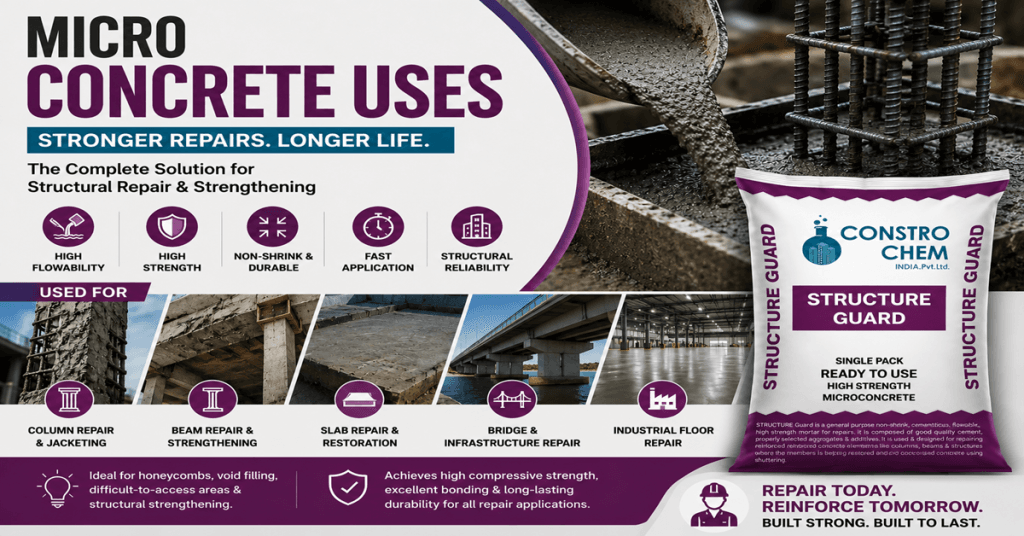
Micro Concrete Uses in Construction & Structural Repair (Complete Guide)
Introduction
Micro concrete has become one of the most essential materials in modern construction and structural rehabilitation. Whether it’s repairing damaged concrete structures or strengthening aging infrastructure, micro concrete offers unmatched versatility, strength, and ease of application.
Unlike conventional concrete, micro concrete is a flowable, high-strength, non-shrink material designed specifically for areas where traditional concrete cannot be placed effectively. It is widely used in repair, retrofitting, and strengthening works across residential, commercial, and infrastructure projects.
Products like ConstroChem Micro Concrete are engineered with high-quality cement, fine aggregates, and corrosion-resistant additives, making them ideal for structural repairs and long-term durability.
What is Micro Concrete?
Micro concrete is a pre-mixed cementitious repair material composed of cement, fine aggregates, and special additives that improve flowability, strength, and durability.
It is specifically designed for:
- Repairing damaged RCC structures
- Filling voids and honeycombs
- Strengthening structural members
It flows easily into tight spaces without vibration and achieves high compressive strength (up to 60 MPa in 28 days).
Top 10 Micro Concrete Uses
1. Column Repair & Jacketing
One of the most important uses of micro concrete is repairing damaged RCC columns.
Why it’s used:
- Columns carry structural load
- Damage reduces safety
- Traditional concrete is hard to apply in narrow sections
Benefits:
- Easily flows into shuttering
- Increases load-bearing capacity
- Ideal for column jacketing
Micro concrete is commonly used to restore structural integrity and extend building life.
2. Beam Repair
Beams are critical load-bearing elements, and cracks or damage can compromise the entire structure.
Applications:
- Crack filling
- Honeycomb repair
- Strength restoration
Why micro concrete works:
- High bonding strength
- No vibration required
- Fast strength gain
It is especially useful in overhead or restricted repair zones where access is difficult.
3. Slab Repair & Strengthening
Micro concrete is widely used in repairing damaged slabs in buildings and industrial floors.
Common issues:
- Cracks
- Spalling
- Water damage
Use cases:
- Residential slabs
- Parking decks
- Industrial flooring
Its flowable nature ensures uniform filling and strong bonding, making it ideal for slab rehabilitation.
4. Bridge & Infrastructure Repair
Infrastructure projects require durable and long-lasting repair materials.
Micro concrete is used for:
- Bridge decks
- Flyovers
- Marine structures
- Dams
Advantages:
- High durability
- Corrosion resistance
- Long service life
It ensures minimal downtime and maximum performance, making it ideal for critical infrastructure.
5. Industrial Floor Repair
Industrial floors often face:
- Heavy loads
- Chemical exposure
- Abrasion
Micro concrete helps in:
- Repairing damaged surfaces
- Restoring level differences
- Increasing durability
It provides high compressive strength and abrasion resistance, ideal for factories and warehouses.
6. Filling Honeycombs & Voids
Honeycombing is a common defect caused by poor compaction.
Problems caused:
- Weak structure
- Reduced durability
- Water ingress
Solution:
Micro concrete is used to:
- Fill voids
- Restore density
- Improve strength
Its self-compacting nature ensures complete filling without vibration, even in deep cavities.
7. Repair of Difficult-to-Access Areas
One of the biggest advantages of micro concrete is its ability to work in restricted or inaccessible areas.
Examples:
- Dense reinforcement zones
- Narrow formwork
- Deep sections
Since it is pumpable and flowable, it can be applied easily where conventional concrete fails.
8. Retrofitting & Structural Strengthening
Old buildings often need strengthening due to:
- Aging
- Increased load requirements
- Structural damage
Micro concrete is used for:
- Jacketing columns
- Strengthening beams
- Repairing load-bearing elements
It enhances load capacity and structural stability, making buildings safer.
9. Precast & Repair Works
Micro concrete is also used in:
- Precast element repair
- Casting small structural components
- Repairing precast joints
Its consistent quality and high strength make it suitable for factory-controlled environments.
10. Marine & Water-Exposed Structures
Structures exposed to water are prone to:
- Corrosion
- Cracking
- Material degradation
Micro concrete benefits:
- Moisture resistance
- No chloride content
- Corrosion protection
This makes it ideal for:
- Water tanks
- Coastal structures
- Sewage systems
Why Micro Concrete is Preferred for These Uses
1. High Strength
Micro concrete achieves up to 60 MPa compressive strength, ensuring durable repairs.
2. Non-Shrink Properties
Prevents cracks and ensures long-term stability.
3. Flowability
Easily fills complex and narrow sections without vibration.
4. Fast Application
Quick setting allows faster project completion.
5. Durability
Resistant to moisture, corrosion, and environmental damage.
How Micro Concrete is Applied
Step-by-Step Process:
- Surface preparation (remove loose concrete)
- Fix shuttering
- Mix micro concrete with water
- Pour or pump into area
- Allow curing
It can be applied in thicknesses of 40–100 mm in a single layer, depending on requirements.
Real-World Example
In structural repair projects:
- Damaged RCC columns are jacketed
- Micro concrete is poured into formwork
- Strength is restored within days
This method is widely used in:
- Old buildings
- Bridges
- Industrial plants
FAQs on Micro Concrete Uses
Where is micro concrete mainly used?
It is mainly used for structural repairs, column jacketing, beam repair, and slab restoration.
Can micro concrete replace traditional concrete?
Not fully — it is mainly used for repair and specialized applications, not large-scale casting.
Is micro concrete waterproof?
It is moisture-resistant and durable, making it suitable for water-exposed structures.
What thickness can be applied?
Typically 40 mm to 100 mm in one application.
Why is micro concrete better for repair?
Because it is:
- Flowable
- Non-shrink
- High strength
- Easy to apply
Conclusion
Micro concrete has transformed the way structural repairs are carried out in modern construction. From column jacketing and beam repair to industrial flooring and infrastructure rehabilitation, its applications are vast and essential.
Its ability to flow into tight spaces, achieve high strength, and resist environmental damage makes it the go-to solution for engineers and contractors.
If you’re planning any repair or strengthening project, choosing a high-quality solution like
👉 ConstroChem Micro Concrete
can ensure durability, performance, and long-term structural safety.
 Call on +91 9323244244 for Exact Micro Concrete Price for your project.