Carbon Fiber Wrap for Column: Complete Guide for RCC Strengthening (2026)
Introduction
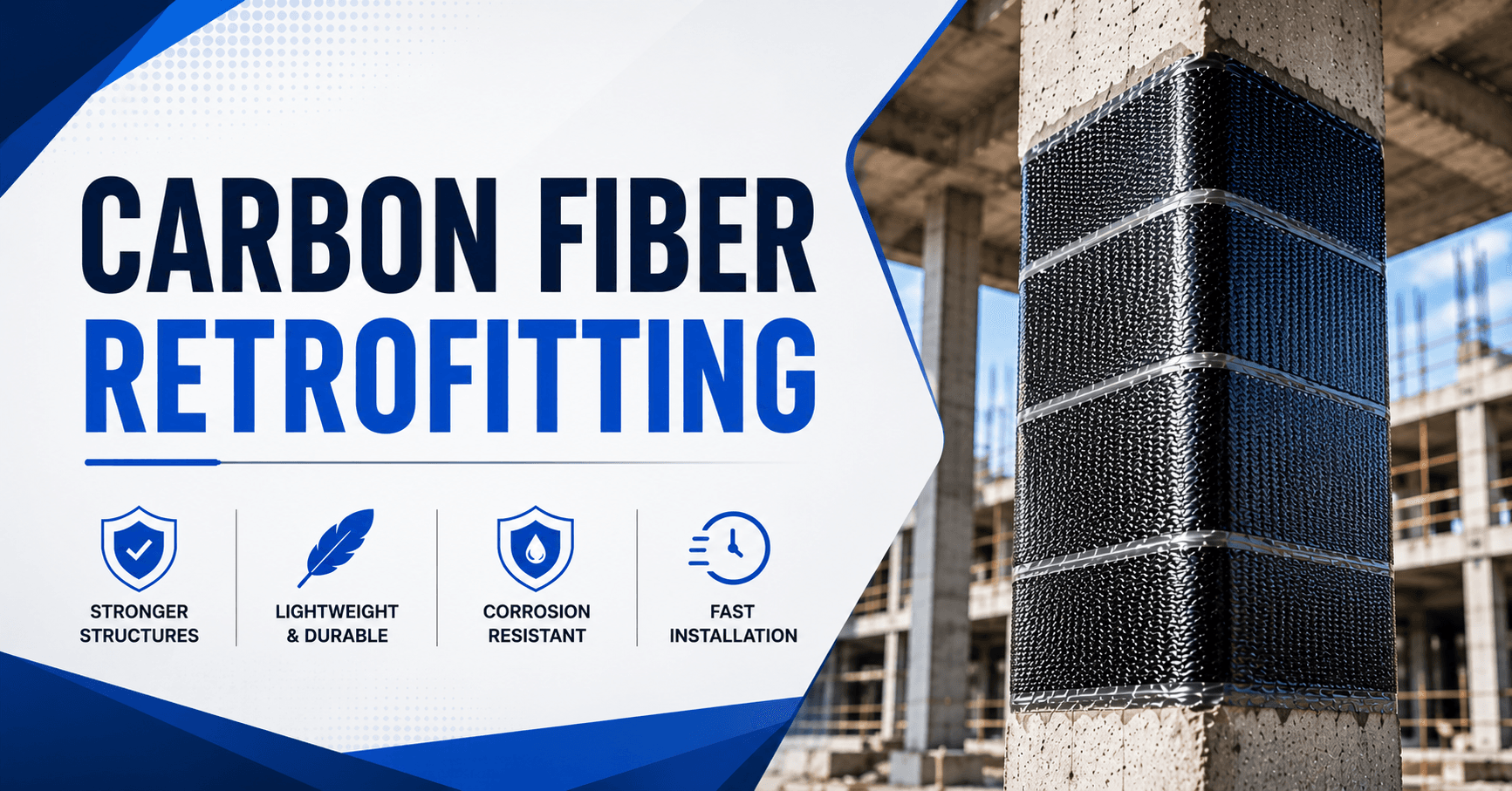
Carbon Fiber Wrap for Column has become one of the most advanced and reliable methods for strengthening reinforced concrete (RCC) structures in India and globally. Whether your structure is facing load increase, seismic vulnerability, corrosion damage, or structural cracks, carbon fiber wrapping provides a fast, durable, and cost-effective solution.
In this complete 2026 guide, you will learn everything about:
- What carbon fiber wrapping is
- Why it is used for columns
- Step-by-step application process
- Design principles
- Advantages over conventional methods
- Cost factors in India
- Real project use cases
What is Carbon Fiber Wrap for Column?
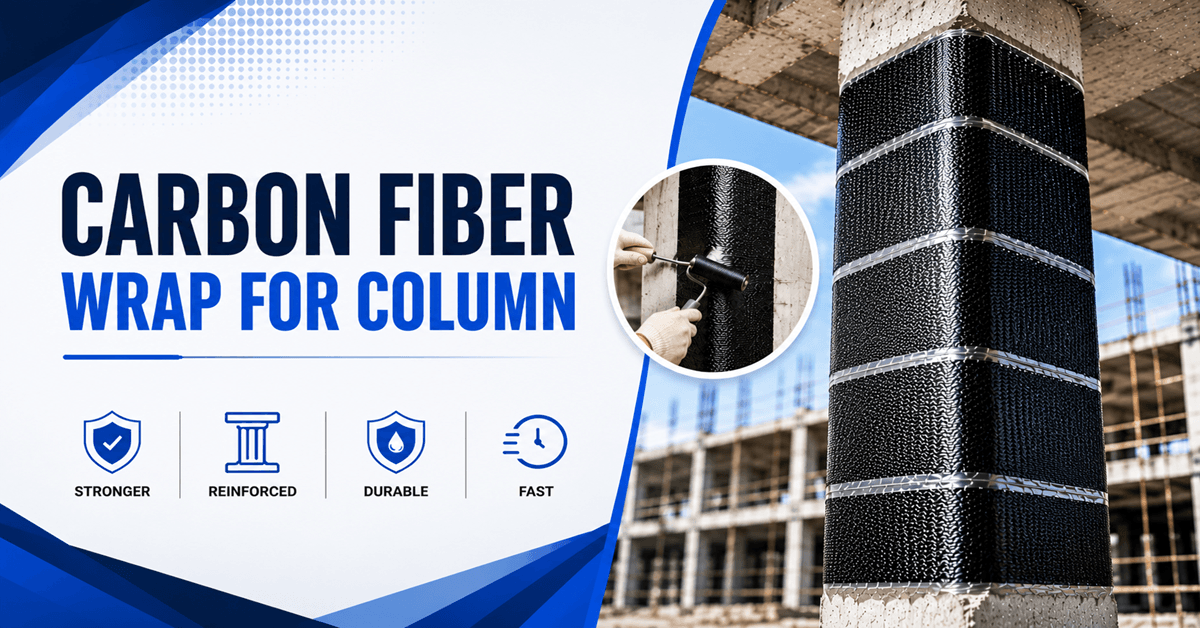
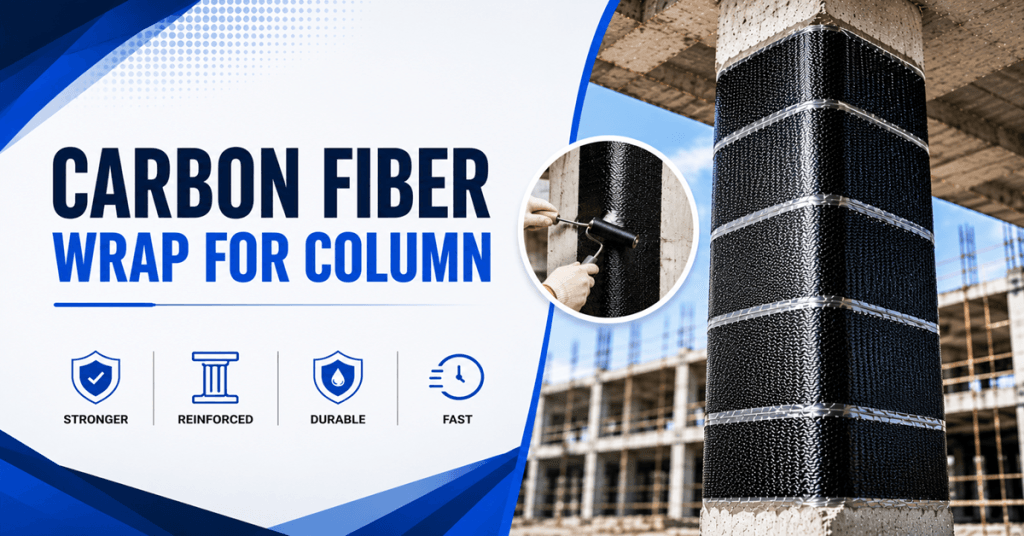
Carbon Fiber Wrap for Column refers to the process of applying CFRP (Carbon Fiber Reinforced Polymer) sheets or fabrics around RCC columns using epoxy resin to enhance their strength and performance.
It works on the principle of confinement, where the carbon fiber wrap:
- Restrains lateral expansion
- Improves compressive strength
- Enhances ductility
- Prevents sudden column failure
Why Column Strengthening is Required
Columns are critical load-bearing elements, and their failure can lead to complete structural collapse. Strengthening becomes necessary in the following cases:
Common Reasons:
- Increase in load (additional floors, machinery)
- Poor construction quality
- Corrosion of reinforcement steel
- Seismic retrofitting requirements
- Aging structures
- Design errors
Benefits of Carbon Fiber Wrap for Column
Key Advantages
- High Strength-to-Weight Ratio
Carbon fiber is 10x stronger than steel but extremely lightweight. - No Increase in Column Size
Unlike jacketing, it does not reduce usable space. - Fast Installation
Can be completed in hours or days. - Corrosion Resistance
Ideal for marine and industrial environments. - Improved Ductility
Essential for earthquake resistance. - Minimal Downtime
Suitable for operational buildings.
How Carbon Fiber Wrap Strengthens Columns
Working Mechanism:
When a column is wrapped with carbon fiber:
- It confines concrete core
- Prevents lateral expansion under load
- Increases axial load capacity
- Enhances shear strength
- Delays crack propagation
This is known as confinement strengthening.
Types of Carbon Fiber Wrapping for Columns
1. Full Wrapping (360° Wrap)
- Entire column is wrapped
- Maximum confinement strength
- Used in seismic zones
2. Partial Wrapping
- Applied only at critical zones
- Cost-effective solution
3. Strip Wrapping
- Carbon fiber strips at intervals
- Used for moderate strengthening
Step-by-Step Application Process
Installation Process
Step 1: Surface Preparation
- Remove loose concrete
- Grind surface for smoothness
- Clean dust and contaminants
Step 2: Crack Repair
- Fill cracks using epoxy injection
Step 3: Primer Application
- Apply epoxy primer for bonding
Step 4: Putty/Leveling
- Ensure smooth surface
Step 5: Resin Application
- Apply saturant resin
Step 6: Carbon Fiber Wrapping
- Wrap CFRP fabric around column
- Maintain proper alignment
Step 7: Roller Application
- Remove air bubbles
Step 8: Final Coating
- Apply protective coating (UV/fire resistant if needed)
Design Considerations for Engineers
Important Factors:
- Column dimensions
- Load calculations
- Number of layers required
- Fiber orientation
- Environmental exposure
- Safety factors
Codes & Standards:
- ACI 440 Guidelines
- IS codes (Indian Standards reference for retrofitting)
Carbon Fiber Wrap vs Traditional Column Jacketing
| Feature | Carbon Fiber Wrap | RCC/Steel Jacketing |
|---|---|---|
| Weight | Lightweight | Heavy |
| Thickness | Very thin | Thick |
| Installation Time | Fast | Slow |
| Durability | High | Moderate |
| Space Impact | No change | Reduces spac |
| Corrosion Resistance | Excellent | Low |
👉 Conclusion: Carbon fiber wrapping is the modern, superior solution.
Applications of Carbon Fiber Wrap for Column
Where It is Used:
- Residential buildings
- Commercial complexes
- Industrial plants
- Bridges & flyovers
- Parking structures
- Marine structures
Factors Affecting Carbon Fiber Wrap for Column
- Area to be wrapped (sq. ft.)
- Number of layers
- Surface condition
- Accessibility
- Material quality (GSM of carbon fiber)
Note: Prices vary depending on project complexity.
Common Mistakes to Avoid
- Poor surface preparation
- Incorrect resin ratio
- Air gaps during wrapping
- Unskilled labor
- Using low-quality materials
Maintenance & Durability
- Lifespan: 20–50 years
- Requires minimal maintenance
- Periodic inspection recommended
Frequently Asked Questions (FAQs)
Is carbon fiber wrapping permanent?
Yes, it provides long-term strengthening when applied correctly.
Can it be used for heavily damaged columns?
Yes, but severe damage may require additional repair methods.
Is it better than jacketing?
In most cases, yes—due to speed, strength, and minimal size increase.
Is it suitable for seismic zones?
Absolutely. It improves ductility and energy absorption.
Conclusion
Carbon Fiber Wrap for Column is revolutionizing the way engineers approach structural strengthening. With its high strength, durability, fast application, and minimal disruption, it has become the preferred solution for RCC column retrofitting in 2026.
If you are planning a column strengthening project, carbon fiber wrapping offers the best combination of performance and cost-efficiency.
Get Expert Consultation
Need help with your project?
👉 Get best carbon fiber price quote
👉 Suitable for residential, commercial & industrial structures
Call / WhatsApp now to strengthen your structure with advanced carbon fiber technology!